The four main types of retaining walls used in New England are segmental block (Allan Block, Versa-Lok), natural stone (fieldstone, granite), poured concrete, and timber. Choice depends on wall height, soil conditions, drainage needs, and budget. Walls over four feet tall typically require an engineer’s stamp and a building permit in Massachusetts. This guide covers each type — when to use it, what it costs, and what makes it fail.
Planning a types of retaining walls project on the North Shore? Call (781) 731-5303 or request a free estimate. Most quotes returned within 24 hours.
Segmental Block Retaining Walls (Most Common)
Concrete blocks designed to interlock and batter back into the slope. Brand names: Allan Block, Versa-Lok, Techo-Bloc Mini-Creta, Cambridge Wall, Belgard:
- Best for — walls 2–10 feet tall. Most common residential choice across the North Shore.
- Cost — $30–$55 per square face foot installed.
- Pros — engineered system, consistent look, fast install, code-compliant for walls up to 10 ft with proper geogrid.
- Cons — modern aesthetic, doesn’t match historic homes or natural settings.
- Engineering required — walls over 4 feet need an engineered design and geogrid reinforcement.
Natural Stone Retaining Walls
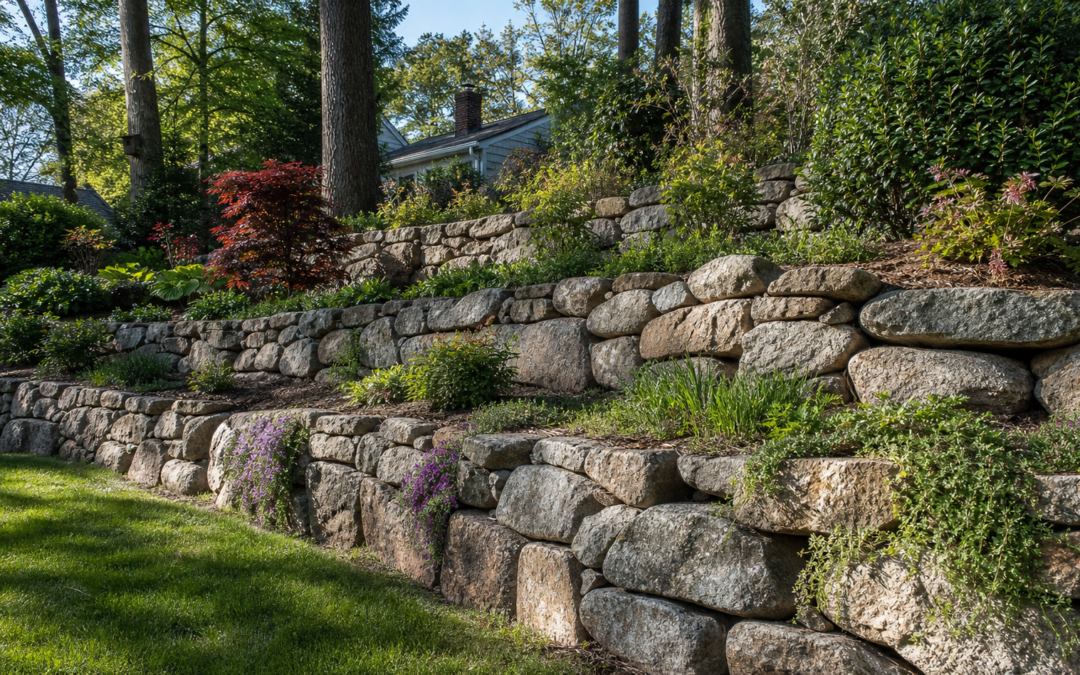
Stacked fieldstone, granite, or quarried stone walls. Premium aesthetic, more labor-intensive build:
- Best for — walls 1–4 ft (dry-stacked) or up to 10 ft (mortared). Historic homes, natural settings, garden walls in Marblehead, Beverly, Newburyport.
- Cost — $60–$140 per square face foot installed.
- Pros — timeless look, ages beautifully, increases property value most of any wall type.
- Cons — most expensive, requires skilled mason, more variability in look.
- Dry-stacked vs mortared — dry-stacked drains naturally and can flex with frost. Mortared is stronger but requires drainage tile and weep holes.
Poured Concrete Retaining Walls
Cast-in-place concrete walls. Strongest type, used for tall or critical walls:
- Best for — walls over 8 feet tall, walls under driveways or structures, walls with surcharge loads.
- Cost — $50–$100 per square face foot installed.
- Pros — strongest wall type, longest lifespan, structurally engineered.
- Cons — utilitarian look unless faced with stone or stucco, expensive forming.
- Always faced — typically faced with stone veneer or stucco for residential use to soften the look.
Timber Retaining Walls (Lower Cost, Shorter Life)
Pressure-treated 6×6 or 8×8 timbers stacked and anchored back into the slope:
- Best for — walls under 4 feet, casual landscape walls, budget-constrained projects.
- Cost — $20–$35 per square face foot installed.
- Pros — cheapest option, natural look, easy install.
- Cons — 15–20 year life max, rots from the back side over time, less code support for taller walls.
- Not recommended — over 4 feet, near pools (chemicals leach into water), in critical structural applications.
Massachusetts Permitting & Engineering Requirements
MA retaining wall rules:
- Walls under 4 feet tall — typically don’t require a building permit. Verify with your town.
- Walls 4 feet and taller — require a building permit. Engineered design (Mass-licensed PE stamp) often required.
- Walls with surcharge loads — even short walls supporting driveways or structures require engineered design.
- Drainage required — perforated drain pipe at the base of every wall over 3 feet tall. Failure to drain is the #1 cause of wall collapse.
- Geogrid reinforcement — required for segmental block walls over 4 ft. Buried fabric grids that tie the wall back into the retained soil.
- Frost-depth footing — 48 inches in Essex County. Walls must extend below frost.
Realistic Retaining Wall Costs in MA (2026)
- Segmental block, 30 ft long x 4 ft tall (120 face sq ft) — $3,600–$6,600
- Natural fieldstone, 30 ft x 4 ft — $7,200–$16,800
- Poured concrete with stone veneer, 30 ft x 4 ft — $9,000–$15,000 (incl. veneer)
- Timber, 30 ft x 4 ft — $2,400–$4,200
- Add for engineered design — $1,500–$4,000 for walls over 4 ft
- Add for drainage system — $400–$1,200
Frequently Asked Questions
What is the best type of retaining wall?
Depends on use case. Segmental block (Allan Block, Versa-Lok) is most common for residential 4–10 ft walls. Natural stone is best for premium aesthetics and historic homes. Poured concrete is required for tall (8 ft+) or structurally critical walls. Timber is cheapest but shortest-lived.
How much does a retaining wall cost in Massachusetts?
Per square face foot installed in 2026: timber $20–$35, segmental block $30–$55, poured concrete $50–$100, natural stone $60–$140. A typical 30-foot long, 4-foot tall block wall (120 sq ft) runs $3,600–$6,600. Same wall in natural stone runs $7,200–$16,800.
Do I need a permit for a retaining wall in MA?
Walls under 4 feet tall typically don’t require a permit. Walls 4 feet and taller require a building permit and often an engineered design (Massachusetts-licensed PE stamp). Walls with surcharge loads (under driveways or near structures) require engineering regardless of height.
How long does a retaining wall last?
Properly built with drainage and frost-rated footings: segmental block 40–60 years, natural stone 75–100+ years, poured concrete 50–75 years, timber 15–20 years. The #1 cause of premature failure across all types is missing drainage — water builds up behind the wall and pushes it forward.
Get a Free Estimate from AB Mendez Masonry & Landscaping
Planning a project on the North Shore of Massachusetts? AB Mendez Masonry & Landscaping is a Massachusetts-licensed home improvement contractor with over 10 years of experience across Lynn, Salem, Beverly, Peabody, Danvers, Marblehead, Gloucester, Swampscott, Newburyport, and Ipswich. Visit our Masonry Contractor services page for materials, process, and pricing — or explore related work: Retaining Wall Construction Lynn MA, Hardscaping.
Call (781) 731-5303 or request a free estimate online. Most quotes returned within 24 hours.