
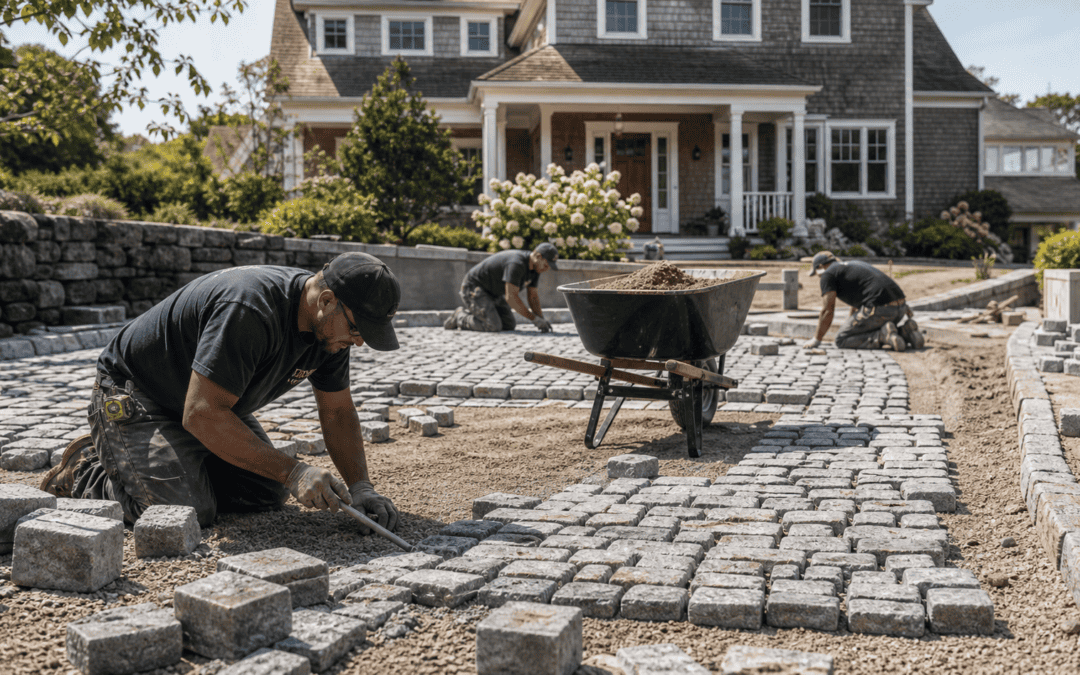
A real stone driveway is granite cobblestone, bluestone, or natural fieldstone set over a 10 to 12-inch compacted processed gravel base with proper edge restraint and drainage — built to outlast asphalt by 30+ years. Done right, a stone driveway lasts 50 years and looks better every season. Done wrong, it heaves and unravels by year 5. This guide covers materials, costs, base prep, and what separates a 50-year stone driveway from a 5-year disappointment.
Planning a stone driveway project on the North Shore? Call (781) 731-5303 or request a free estimate. Most quotes returned within 24 hours.
Stone Driveway Material Options
Three stone driveway materials work in New England. Each has trade-offs:
- Granite cobblestone — historic, premium look. Period-correct for Marblehead, Newburyport, Salem historic districts. $40–$70/sq ft installed. 50+ year life. Best in class for durability.
- Reclaimed granite cobble — antique cobbles salvaged from old streets. Even more character. $50–$90/sq ft installed.
- Bluestone (thermal cut) — flat, modern. Less common for driveways than walkways but works for short driveways under 30 ft. $35–$55/sq ft installed.
- Belgian block driveway — Belgian-block cobbles cover the whole driveway, not just the border. $35–$60/sq ft installed.
- Hybrid: cobble apron + asphalt or paver center — best value path. Cobble apron at the street (4–8 ft deep) for character, asphalt or pavers for the rest. $8,000–$18,000 added to a standard driveway cost.
The Base: Where Most Stone Driveways Fail
A stone driveway is only as durable as the base under it. The single biggest failure mode is inadequate base prep:
- 10–12 inches of compacted processed gravel — Mass DOT M1.03.0 Type a, 1.5″ minus. Compacted in 4-inch lifts.
- Geotextile separator fabric over clay subsoils — prevents the gravel from migrating down into clay and the clay from migrating up into the gravel.
- 1-inch bedding sand layer — coarse concrete sand, not stone dust. Levels and beds the stones.
- Edge restraint — concrete haunch or plastic spiked restraint. Without it, the perimeter cobbles walk outward under tire loads.
- Polymeric sand joints — locks the stones together, prevents weed growth. Re-apply every 8–10 years.
Drainage: Stone Driveways & Water Management
Stone driveways drain BETTER than asphalt because water can pass through the joints. But you still need to manage where the water goes:
- Open-graded base (permeable design) — for fully permeable installs, use #57 stone or larger as the base. Water drains through the driveway into the ground.
- Closed base (traditional design) — compacted processed gravel + sand + polymeric sand joints. Water runs off the surface. Crown 1/4″ per foot.
- Drain channels at the apron — trench drain or stone-set channel to capture runoff before it hits the street.
- Dry well or daylight outlet — connected to channel drains, manages runoff on-site.
Realistic Stone Driveway Costs in MA (2026)
For a typical North Shore residential driveway (20×40 = 800 sq ft) in 2026:
- Full granite cobblestone (800 sq ft) — $32,000–$56,000
- Reclaimed granite cobble (800 sq ft) — $40,000–$72,000
- Bluestone driveway (800 sq ft) — $28,000–$44,000
- Hybrid: cobble apron (50 sq ft) + asphalt center — $10,000–$15,000 total
- Add for demo of existing driveway — $1,500–$3,500
- Add for drainage upgrades — $1,500–$5,500
Stone Driveway Maintenance (Annual Tasks)
Stone driveways are LOWER maintenance than asphalt, not zero maintenance:
- Sweep polymeric sand back into joints — annual spring task. Top up as needed.
- Replace polymeric sand entirely — every 8–10 years. Full re-application.
- Pressure wash — every 2–3 years to clear moss, dirt, salt residue.
- Lift & reset settled cobbles — individual cobbles can be lifted and reset without disturbing the rest. This is one of stone’s biggest advantages over asphalt or concrete.
- Re-seal individual stones if desired — natural stone sealer enhances color and protects against salt. Optional.
Frequently Asked Questions
How much does a stone driveway cost in Massachusetts?
For a typical 20×40 (800 sq ft) North Shore residential driveway in 2026: full granite cobblestone runs $32,000–$56,000. Bluestone runs $28,000–$44,000. A hybrid design with cobble apron and asphalt center is much more affordable at $10,000–$15,000 total.
How long does a stone driveway last?
50+ years with proper installation and basic maintenance. The stone itself lasts virtually forever. The bedding sand and polymeric joint sand need refresh every 8–10 years. Individual cobbles can be lifted and reset if anything settles — a huge advantage over asphalt or concrete driveways that crack.
Can you snow plow a stone driveway?
Yes — use a rubber-edged plow (not steel) to avoid chipping the stones. Most pro plow services have rubber-edge attachments available. Stone driveways with properly set polymeric sand joints handle plowing fine. Loose-set cobbles without proper joint sand will pop out under plowing.
Is a stone driveway worth the cost?
For premium homes (historic districts, custom builds, properties over $1M), stone driveways add curb appeal and resale value beyond their cost. For everyday homes, a hybrid design (cobble apron + asphalt or paver center) gets 80% of the visual impact at 30% of the cost. We’ll quote both options and let you decide.
Get a Free Estimate from AB Mendez Masonry & Landscaping
Planning a project on the North Shore of Massachusetts? AB Mendez Masonry & Landscaping is a Massachusetts-licensed home improvement contractor with over 10 years of experience across Lynn, Salem, Beverly, Peabody, Danvers, Marblehead, Gloucester, Swampscott, Newburyport, and Ipswich. Visit our Driveway Installation services page for materials, process, and pricing — or explore related work: Masonry Contractor, Custom Walkways.
Call (781) 731-5303 or request a free estimate online. Most quotes returned within 24 hours.